🏠 Home
Build Hope
Help every family have a place to call home — funded through OseloHelp.com, our tax-exempt non-profit corporation.
Part of the Admerk Ecosystem
Loading the music…
Our Purpose
We invite everyone to help leave a legacy for humanity.
Join Three Missions That Will Outlive Us All

Build Hope
Help every family have a place to call home — funded through OseloHelp.com, our tax-exempt non-profit corporation.

Preserve Humanity Through Music
Preserve humanity's music and stories for the next 1,000+ years.
A simple way to help
If this directory helped you, please help preserve this heritage — share TimTim.Live. One conversation can keep a thousand-year memory alive.

Inspire the Next Generation of Explorers
Make the opportunity to explore space available to everyone.
How it all connects
Nothing here is a separate business — each stage strengthens the next.
One purpose. Many reinforcing businesses.
Whether you listen to a song, share a story, wear the merchandise, attend a concert, translate lyrics, recommend a country, or simply tell a friend — you become part of something designed to last for generations.
Everyone can participate. No contribution is too small.
TimTim.Live — The World's Friendship Platform, Powered by Music.
Connecting people across 195 countries, 245 local languages, and 50,000 cities worldwide.
© 2026 TimTim.Live. All Rights Reserved.

The birthplace of Konpa
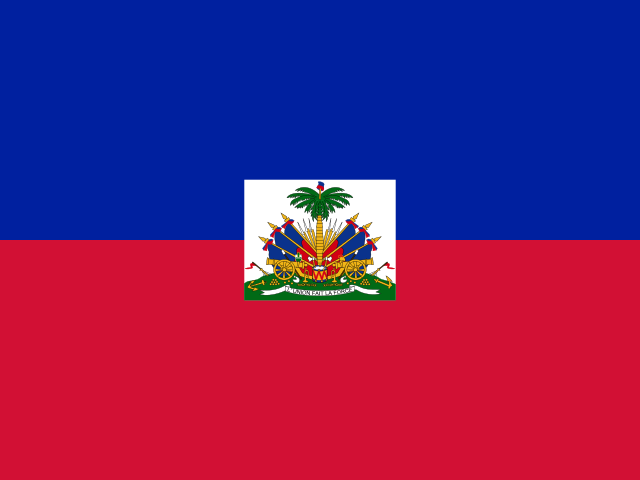
Haiti is a Caribbean nation and the birthplace of Konpa, its smooth national dance music. It is the world’s first Black-led republic (independent since 1804), and its culture lives loudest through rhythm, food, and celebration. TimTim.Live was born here, in Les Cayes.
Help represent Haiti →Haiti shares the island of Hispaniola with the Dominican Republic. In 1804, after a thirteen-year revolution, it became the first nation born from a successful revolt of enslaved people — and the first independent country in Latin America and the Caribbean.
That spirit of freedom runs through everything Haitian, especially the music. From ceremonial drumming to modern Konpa, Haitian sound has always been a way to remember where you come from and celebrate that you’re still here.
The Haitian Revolution begins — the largest and most successful uprising of enslaved people in history.
Haiti declares independence on January 1st, becoming the world's first Black-led republic.
Saxophonist Nemours Jean-Baptiste creates Konpa, the dance music that becomes Haiti's national sound.
Haiti marks 200 years of independence — bicentennial celebrations nationwide.
During French colonial rule, enslaved Haitians were forbidden from tasting the rich pumpkin soup they cooked for their enslavers. When independence was declared on January 1, 1804, the very first thing free Haitians did was make soup joumou for themselves. Today, every Haitian household — at home or across the diaspora — shares a bowl of it every New Year's Day, a taste of freedom passed down for over two centuries.
Ask any Haitian grandparent about Bouki and Malis and you'll get a smile before the story even starts. Bouki, the good-hearted but gullible one, and Malis, the clever trickster, star in dozens of Haitian folktales told at evening gatherings — usually kicked off with the call-and-response “Krik? Krak!” These stories, rooted in West African oral tradition, still open with a joke and close with a lesson.
The call-and-response that opens every Haitian storytelling session.
Neighbors working a family's field together, powered by drumming and song.
The extended family compound — the center of rural Haitian life.
Dressing up and gathering as family after church.
Music is the heartbeat of Haiti. Konpa — created in 1955 by saxophonist Nemours Jean-Baptiste — is the smooth, mid-tempo dance music you’ll hear at every celebration. Around it live a whole family of styles, from acoustic troubadour songs to the trance rhythms of Rara.
The national dance music — smooth, steady, made for dancing close.
Acoustic, storytelling songs led by guitar and accordion.
“Roots music” blending Vodou ceremonial rhythms with rock.
Processional street music played during Lent.
The older Haitian style Konpa grew out of.
Close, smooth partner dancing — small steps, hips leading the rhythm.
A ceremonial, wave-like dance rooted in Vodou tradition.
A playful, hip-driven dance from the Gede spirits' celebrations.
A processional street dance following the band through town.
Hand drums at the center of Rara and ceremony.
Heart of twoubadou and early Konpa.
The signature lead of Nemours-era Konpa.
Bamboo trumpets that drive Rara bands.
A metal scraper that keeps the groove.
Maracas / shakers.
Haitians speak Haitian Creole (Kreyòl) and French. Kreyòl is the everyday language of nearly everyone in Haiti and is the language most TimTim.Live songs are sung in.
| Phrase | Meaning |
|---|---|
| Bonjou | Good morning / hello |
| Bonswa | Good evening |
| Koman ou ye? | How are you? |
| N ap boule | We’re doing well (casual) |
| Mèsi | Thank you |
| Orevwa | Goodbye |
Freedom soup, eaten every Jan 1 — UNESCO cultural heritage.
Rice and beans, the everyday staple.
Marinated, fried pork — a party favorite.
Spicy pickled slaw that goes with everything.
Twice-fried plantains.
Crispy malanga fritters.
The New Year's Day "freedom soup" — hearty, golden, and shared with family every January 1st.
Ingredients
Steps
🍺 Drink traditions
Haiti's drink traditions run from Barbancourt rum — aged in the same French oak tradition as fine cognac — to Prestige, the national lager enjoyed at every celebration. A toast is rarely quiet: expect a call of “Sante!” (health/cheers) before the first sip, and rum poured on the ground first for the ancestors at Vodou ceremonies.
See how TimTim.Live carries that spirit into 888 Lucky Beer →Mountaintop fortress and UNESCO World Heritage site.
Royal ruins near Milot in the north.
Turquoise waterfall pools near Jacmel.
Peaceful island off the southern coast, near Les Cayes.
Beaches along the northern coast.
Carnival — the biggest party of the year, famous in Jacmel.
Street bands that fill the roads through Lent.
The Port-au-Prince International Jazz Festival.
Independence Day, Jan 1 — served with soup joumou.
The capital and heartbeat of Haitian music.
TimTim.Live’s hometown on the southern coast.
Historic northern city by the sea.
Haiti’s arts and carnival town.
Where independence was declared in 1804.
Known as the “city of poets.”
Choose a place, add a personal dedication, and send “Gita Blan” to one person who'd love it — free, always. It could be the start of a friendship.
Performances and behind the scenes.
✅ TimTim.Live has performed in Haiti
Festivals, cultural celebrations, corporate events, and universities — request a Konpa show in Haiti and the booking team will follow up with availability.
See the full press kit & tour info →Translation changes words. Localization makes people feel that the movement understands them.
Read them in the Stories section above.
Haiti’s ambassadors help share Konpa with their cities and welcome new friends into the family.
Become Haiti's Founding Explorer →Pick your language on the song page — every song is offered as a gift in the language you choose.
Haiti's own mission artwork is coming soon — every country gets one.
Be the first Founding Explorer from Haiti.
Get new Haiti songs, stories, and events first — straight to your inbox.
Haiti’s ambassadors help share Konpa with their cities and welcome new friends into the family.


The Friend Loop
Choose a country · Hear a song · Learn one tradition · Say hello. Do it again tomorrow.
Hear a song
Smile
Learn about a country
Say hello
Make a friend
Share another song
Konpa (also spelled Kompa) — Haiti’s smooth, joyful national dance music, created in 1955 by Nemours Jean-Baptiste.
Haitian Creole (Kreyòl) and French. Most TimTim.Live songs are sung in Kreyòl.
In 1804 Haiti became the first Black-led republic and the first independent nation in Latin America and the Caribbean, born from a successful revolution of enslaved people.
A pumpkin/squash “freedom soup” eaten every January 1st to celebrate independence. It’s recognized by UNESCO as intangible cultural heritage.
TimTim.Live was born in Les Cayes, a city on Haiti’s southern coast.