TIMTIM SPACE FAMILY · ACCESS TO SPACE FOR HUMANITY
Dream it. Learn it. Build the knowledge together.
Have you ever looked at the Moon and wondered if you might go there someday? Whether you are eight, eighty, a teacher, an artist, a scientist, or simply curious, there is a place for you here.
The formal initiative is the TimTim.Live Open Human Spaceflight Initiative. It investigates an open question — can human spaceflight architectures materially reduce reliance on conventional onboard chemical propulsion while staying physically feasible, affordable and survivable? — and every answer, including no and not with current technology, is a legitimate result. It is not claiming a built spacecraft, proven system, selected technology, or institutional endorsement.
WELCOME, EXPLORER
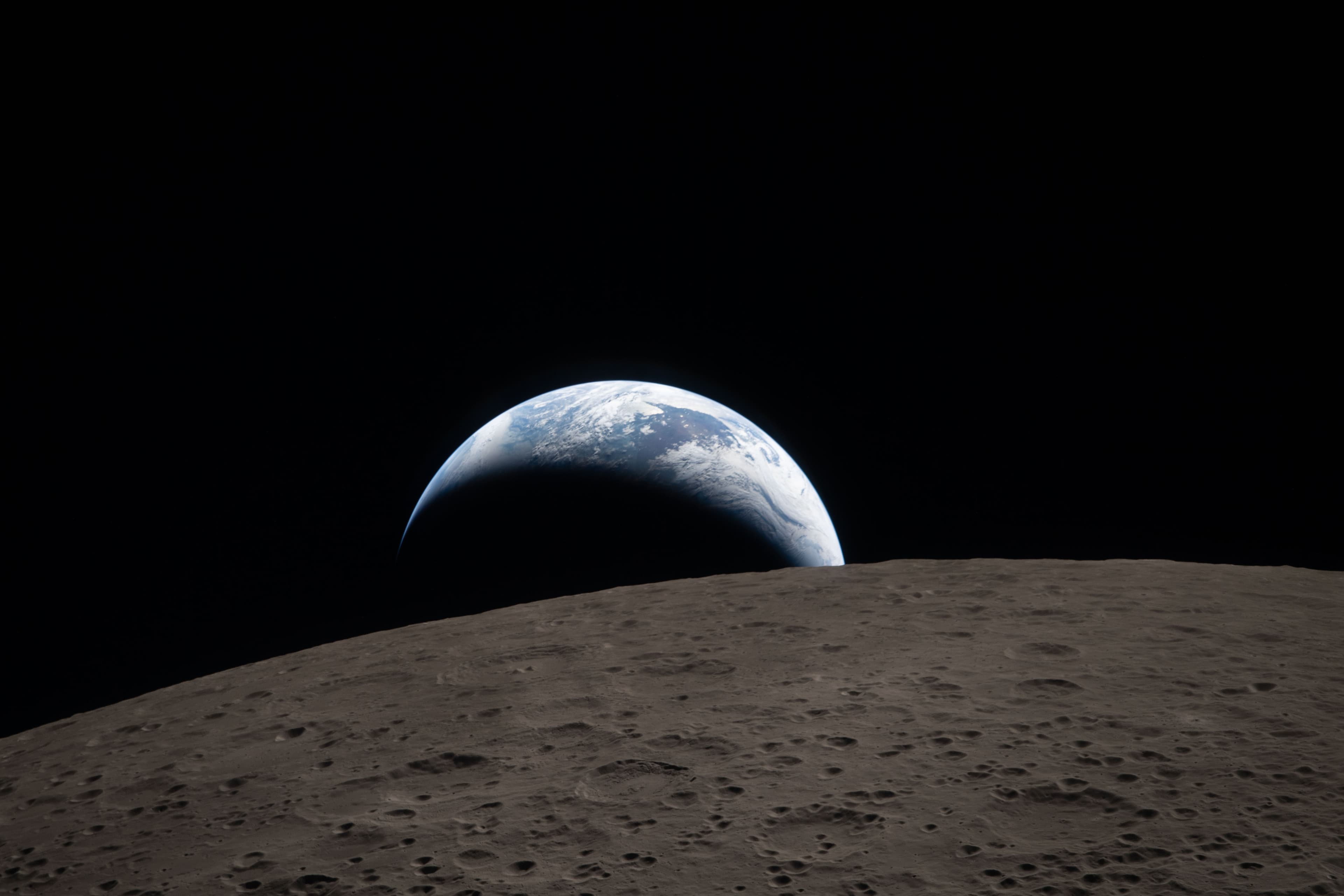
If you can see the Moon, you already belong.
Somewhere tonight, a child will look at the Moon and wonder what is out there.
A scientist may look at that same Moon from a laboratory.
An engineer may see a problem waiting to be solved.
A university student may see a future career.
Someone in a small village, thousands of miles from the world's major space centres, may simply look up and dream.
They are all looking at the same Moon. And they all belong in humanity's conversation about what comes next.
Look up.
The sky does not ask where you were born.
The Moon does not ask what language you speak.
Curiosity does not ask for a passport.
And imagination does not require permission.
That is the idea behind the TimTim.Live Global Space Exploration Initiative — an open worldwide community bringing together scientists, engineers, professors, researchers, students, inventors, innovators, space enthusiasts, young people and curious minds to explore how humanity might make space transportation safer, more accessible and less expensive.
You do not need to be invited into humanity's future.
If you have ever looked at the Moon and wondered what might be possible, you are already part of the story.
- If you question how things work, you belong.
- If you have an idea, you belong.
- If you are willing to learn, you belong.
- If you are simply curious, you belong.
No passport. No permission. No special invitation.
A brilliant idea could come from:
- a NASA laboratory
- a university in India
- an engineer in Cameroon
- a researcher in Sweden
- a student in Haiti
- an inventor in Brazil
- a professor in China
- a curious young person in a village whose name has never appeared in a space conference
Human potential is not limited by geography. Neither should humanity's imagination be.
You were already an Explorer.
You do not become an Explorer because TimTim.Live gives you the title. Curiosity made you one. The moment you looked beyond what was known and asked “What if?”, the journey had already begun.
Our purpose is simply to help Explorers around the world find one another — scientists with students, engineers with dreamers, universities with independent thinkers, experienced professionals with the next generation, and people from countries with major space programmes with people from communities that have rarely been included in the conversation.
One shared horizon.
This is not one nation's Moon. This is not one generation's dream. When humanity looks upward, borders disappear. From Earth there is one sky above us, one Moon that billions of people can see, one universe waiting to be understood, and one human family asking what lies beyond.
ONE SKY · ONE MOON · ONE DREAM
Welcome, Explorer.
Our journey begins under the same sky.
The initiative is at the research and feasibility stage. It explores concepts that could one day contribute to areas including suborbital transportation, satellite deployment and human exploration beyond Earth. No spacecraft or spaceflight service has been built, proven or offered for sale.
01
Dream
Where could humanity go?
Imagine Earth from above, a future Moon visit, or a new way to travel. Curiosity is a real beginning.
Begin this path →
02
Learn
How does space really work?
Explore space through stories, experiments, activities, and clear explanations built for every generation.
Begin this path →
03
Build the Knowledge
What does the evidence say?
Follow open questions, sources, assumptions, uncertainty, review, correction, and carefully earned conclusions.
Begin this path →
SAME PROJECT · DIFFERENT DEPTH
Every important idea should welcome you in before it asks more of you.
A child should be able to ask why a spacecraft does not melt on the way home. A student should be able to learn the science. A technical contributor should be able to examine the evidence and its limits.
EXPLAIN IT SIMPLY
Start with wonder.
Short stories, pictures, questions, and experiments for curious children, families, and anyone seeing a space idea for the first time.
THE HONEST QUESTION
Can humanity develop safe, reusable, and affordable spacecraft architectures that reduce reliance on conventional onboard chemical rocket propulsion?
We do not know yet. Help us find out.
The project may find that an idea works, might work, needs more research, or does not work. A well-supported negative result is still valuable knowledge.
See the research standardsYOU CAN HELP BY
OPEN, CAREFUL, AND HUMAN
Knowledge grows stronger when people can inspect it, question it, and improve it together.
TimTim.Live is being shaped as the public home for learning, conversation, contributions, sources, reviews, translations, and recognition—without requiring visitors to leave the community to participate.
01
Hypothesis
02
Literature Supported
03
Modeled
04
Experimentally Supported
05
Independently Reproduced
06
Verified for Research Use
07
Rejected / Contradicted
Research-evidence labels are not certification, airworthiness, regulatory approval, human-rating, or proof of flight safety. NASA imagery is used as visual context only and does not imply affiliation or endorsement.